

Increase in Outpatient Ivermectin Dispensing in the US During the COVID-19 Pandemic: A Cross-Sectional Analysis
Ivermectin Dispensing US During COVID-19: Cross-Sectional Analysis
INTRODUCTION
Ivermectin dispensing US during COVID-19 became an important public health topic as prescriptions for this antiparasitic medication increased during the pandemic. Ivermectin oral tablets are used worldwide for treatment of certain parasitic infections. An in vitro study has shown that ivermectin inhibits the replication of SARS-CoV-2 in tissue cell cultures. in vitro study
Some observational studies and clinical trials have evaluated ivermectin for the treatment and prevention of COVID-19 in humans; however, most had incomplete information and methodological limitations. Clinical trials Human data from well-designed and well-conducted clinical trials with robust sample sizes are needed to provide more specific, evidence-based guidance on the role of ivermectin for the treatment or prevention of COVID-19.
For additional information about ivermectin tablets and formulations, readers can also explore our Ivermectin Tablets USP 40mg guide.
METHODS
Ivermectin dispensing US during COVID-19 was assessed using outpatient retail prescription data from the IQVIA National Prescription Audit Weekly (NPA Weekly, hereafter abbreviated NPA).
To understand whether there have been changes in outpatient ivermectin dispensing during the COVID-19 pandemic, CDC tracked outpatient retail prescription data from the IQVIA National Prescription Audit Weekly (NPA Weekly, hereafter abbreviated NPA) for the estimated number of ivermectin prescriptions dispensed from retail pharmacies weekly during March 14, 2020–April 2, 2021.
These estimates were compared to a pre-pandemic baseline weekly average during the 52-week period from March 16, 2019–March 13, 2020, before the declaration of a national emergency.
Monthly state-level data from the IQVIA Total Patient Tracker (TPT) were then analyzed to assess whether observed changes were due to changes in particular states where the dispensing pharmacies are located.
NPA and TPT both collect data from a sample of approximately 48,900 US retail pharmacies, representing 92% of all retail prescription activity nationwide. IQVIA data
NPA data were used to estimate the total number of ivermectin prescriptions dispensed from retail pharmacies nationally, while TPT data and 2019 intercensal estimates from the US Census Bureau were used to estimate state-specific ivermectin dispensing rates per 100,000 population.
These data do not include prescribing indications. Ivermectin dispensed by mail order and long-term care pharmacies, prescriptions by veterinarians, and non-oral formulations were not included.
This activity was reviewed by CDC and was conducted consistent with applicable federal law and CDC policy. CDC policy
RESULTS
During March 16, 2019–April 2, 2021, national estimates of ivermectin dispensed from outpatient retail pharmacies increased from an average of 3,589 prescriptions per week at the pre-pandemic baseline to a peak of 39,102 prescriptions in the week ending on January 8, 2021. This represented a 989% relative percent increase. See Figure 1
Monthly state-based analyses revealed that an initial increase in ivermectin dispensing observed in July 2020 largely involved increased dispensing rates in Texas and Florida. See Figure 2
By January 2021, ivermectin dispensing rates had increased in all states. The three states with the highest estimated rates of dispensing were Texas (151.8 per 100,000 population), Oklahoma (106.5 per 100,000 population), and Georgia (76.9 per 100,000 population).
Ivermectin dispensing decreased after January 2021 but remained elevated compared with pre-pandemic levels. These findings provide additional information about Ivermectin dispensing US during COVID-19.
Figure 1
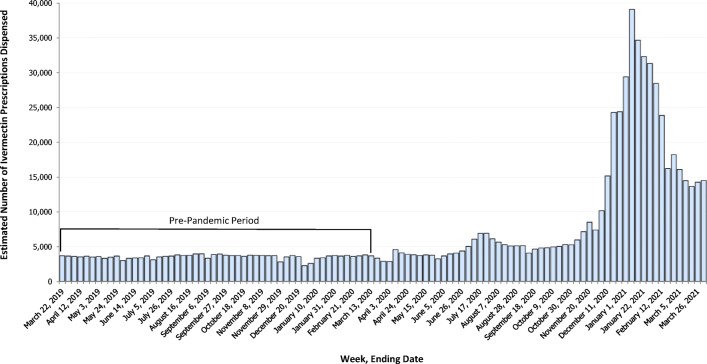
Estimated number of outpatient ivermectin prescriptions dispensed from retail pharmacies — US, March 16, 2019–April 2, 2021. Data are from the IQVIA National Prescription Audit Weekly (NPA Weekly) database.
NPA Weekly collects data from a sample of approximately 48,900 US retail pharmacies, representing 92% of all retail prescription activity. National estimates of weekly ivermectin prescriptions dispensed are indicated by blue bars, and the bracket indicates the pre-pandemic period from March 16, 2019 to March 13, 2020.
Ivermectin dispensed by mail order and long-term care pharmacies, prescriptions by veterinarians, and non-oral formulations were not included.
Figure 2
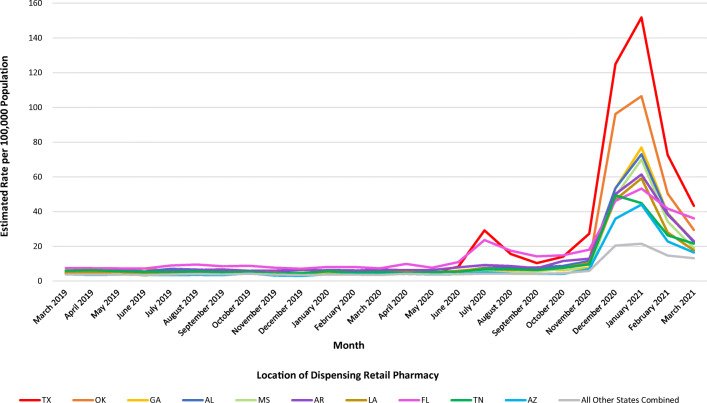
Estimated rate per 100,000 population of unique patients receiving ivermectin dispensed from retail pharmacies by state and the District of Columbia — US, March 2019–March 2021.
Monthly state-level estimates of outpatient retail prescription data are from the IQVIA Total Patient Tracker (TPT) database and the 2019 intercensal estimates are from the US Census Bureau. TPT collects data from a sample of approximately 48,900 US retail pharmacies, representing 92% of all retail prescription activity.
TPT estimates numbers of unique patients receiving ivermectin prescriptions dispensed by the state where the dispensing retail pharmacy is located. The 10 states with the highest estimated rates of ivermectin dispensing from pharmacies located in their state in January 2021 are displayed individually: red line is Texas, orange line is Oklahoma, yellow line is Georgia, dark blue line is Alabama, light green line is Mississippi, purple line is Arkansas, brown line is Louisiana, pink line is Florida, dark green line is Tennessee, light blue line is Arizona; and all other states are combined in the gray line.
Ivermectin dispensed by mail order and long-term care pharmacies, prescriptions by veterinarians, and non-oral formulations were not included.
DISCUSSION
Ivermectin dispensing US during COVID-19 increased substantially in outpatient retail pharmacies during the pandemic. While initial increases largely involved increased dispensing rates in Texas and Florida, by January 2021, ivermectin dispensing rates had increased nationwide.
These data are subject to at least three limitations. First, NPA and TPT do not include inpatient prescription data, and thus are not representative of all ivermectin dispensing.
Second, without prescribing indication, it is unknown whether the increased ivermectin dispensed was used to treat non-COVID-19 conditions (i.e., parasitic infections).
However, the increase in the number of outpatients who received ivermectin from retail pharmacies observed during the pandemic followed publication of the previously mentioned in vitro study and increases in COVID-19 cases in the US. COVID-19 case data
Third, patients receiving ivermectin may not reside in the same state where the dispensing pharmacy is located.
These limitations should be considered when interpreting data related to Ivermectin dispensing US during COVID-19.
Clinicians should be aware that ivermectin is not currently authorized or approved by FDA for treatment of COVID-19, and FDA cautions against use for this purpose. FDA guidance
Furthermore, the National Institutes of Health’s COVID-19 Treatment Guidelines Panel determined that there are currently insufficient data to recommend either for or against the use of ivermectin for treatment of COVID-19. Clinical trials
Readers looking for general information about obtaining ivermectin in the US can also review our How to Safely Get Ivermectin in the US guide.
As of May 2021, only investigational monoclonal antibody therapies are authorized by FDA for treatment of non-hospitalized high-risk persons with mild-to-moderate COVID-19.
It is important for clinicians to consider SARS-CoV-2 infection prevention measures, vaccination, and authorized treatments before prescribing therapies that are not authorized or approved for the treatment or prevention of COVID-19.
Overall, the available prescription data show that Ivermectin dispensing US during COVID-19 increased substantially compared with pre-pandemic levels, with increases eventually observed across all states.



Just signed up with winvndvp. The welcome bonus is pretty sweet! Looking forward to seeing what this site has to offer. winvndvp
I don’t think the title of your article matches the content lol. Just kidding, mainly because I had some doubts after reading the article.